Job Description : Interships – Pune Sponge Cities Collective
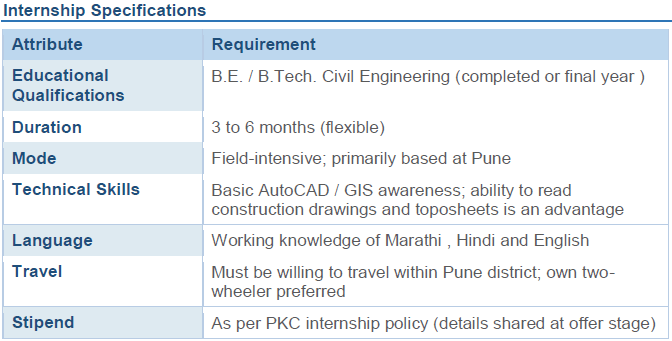
STREAM 1 — CIVIL ENGINEERING INTERN
Role Overview: As a Civil Engineering intern, you will work alongside our Associate Project Manager – Civil Engineer to conduct site surveys, prepare drawings, and support the hands-on implementation of sponge city infrastructure, including permeable pavements, rain gardens, and recharge pits. This is a field-intensive role — you will spend time outdoors across Pune’s project sites, not only at a desk.
What You Will Do:
Site Surveys & Field Investigations
• Assist in surveying potential recharge zones across Pune neighbourhoods
• Help collect topographic and hydrological field data, including runoff pathways and catchment boundaries
• Support storage potential assessments of existing ponds, tanks, and proposed recharge structures
Drawing & Technical Documentation
• Assist in preparing 2D CAD drawings from field measurements under senior engineer guidance
• Help compile Bills of Quantities (BoQ) and basic material estimates for pilot structures
• Maintain organised field notebooks, site photographs, and daily activity logs
Construction Supervision Support
• Observe and document construction activities at the pilot sponge city site
• Assist in monitoring sensor installation (piezometers, IoT rain gauges) at field sites
• Record basic sensor data and generate reports.
Community & Stakeholder Interaction
• Participate in community mapping exercises to document local rainwater harvesting potential areas
• Attend stakeholder workshops, undertake surveys and structured notes for project records
What You Will Learn
• Applied hydrogeology and urban water cycle concepts in a real city context
• Field survey protocols for water conservation projects
• Sponge city design principles: bioswales, permeable pavements, rain gardens, etc.
• Construction supervision basics for nature-based infrastructure
• Interdisciplinary teamwork with geologists, social workers, and municipal officials
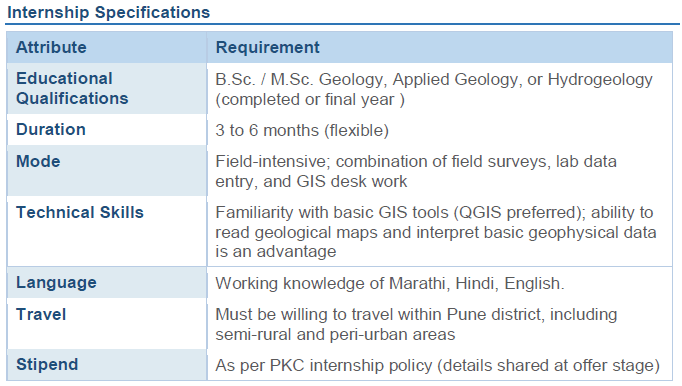
STREAM 2 — GEOLOGY INTERN
Role Overview: As a Geology intern, you will support the technical core of the Sponge Cities Collective — identifying groundwater recharge zones, mapping aquifers in Pune’s hard-rock Deccan terrain, and assisting in the supervision of recharge structures. You will work directly under our Associate Project Manager (Geologist) and gain hands-on experience in applied hydrogeology in an urban setting.
What You Will Do:
Field Investigations & Mapping
• Assist in hydrogeological field surveys to identify geological features and potential groundwater recharge zones across Pune
• Help conduct community mapping of dug wells, borewells, minor irrigation structures, and local water bodies
• Support lithology logging and basic water level monitoring at selected sites
Data Collection & Logging
• Record field observations — water table levels, soil characteristics, and geological formations — into structured logs
• Assist in collating field data into the project’s central decision-support database
• Help prepare summary tables and data sheets for technical reporting
Recharge Structure Support
• Observe and document the construction/installation of recharge shafts, recharge pits, and injection wells
• Assist in conducting basic pumping or slug tests to estimate aquifer yield under senior geologist supervision
• Monitor water quality parameters (basic field tests) at pilot sites
GIS & Spatial Analysis
• Assist in digitising field-collected data on GIS platforms for spatial mapping
• Help prepare thematic maps showing recharge zones, water body locations, and geological units
What You Will Learn
• Applied hydrogeology in Deccan Trap hard-rock terrain — a unique and professionally valuable exposure
• Field survey techniques for urban groundwater assessment
• Groundwater monitoring equipment and data logging practices
• Basics of aquifer characterisation: pumping tests, slug tests, lithology interpretation
• GIS-based spatial mapping for water resource projects
• Integration of community knowledge with technical hydrogeological analysis
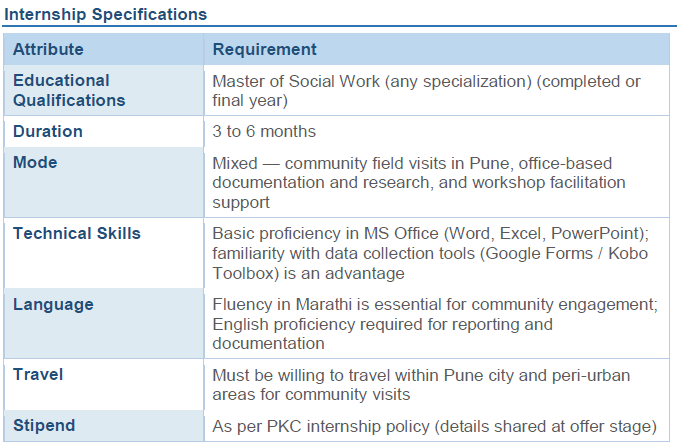
STREAM 3 — SOCIAL WORK INTERN
Role Overview:
As a Social Work intern, you will be the community-facing bridge of the Sponge Cities Collective. You will support stakeholder coordination, community mobilisation, participatory mapping, and capacity building activities — working alongside the Associate Project Manager (Research – Water Security). This role is ideal for students who want hands-on experience in the development sector with a strong environmental and urban governance lens.
What You Will Do
Community Engagement & Mobilisation
• Assist in facilitating community workshops on urban water challenges and sponge city concepts in Pune neighbourhoods
• Support participatory mapping exercises to document local water bodies, drainage patterns, and resident water use practices
• Help identify and connect with Water Committees, Resident Welfare Associations, and local champions for project activities
Stakeholder Coordination
• Assist in coordination with local government authorities, gram panchayats, and municipal wards to schedule site visits and meetings
• Prepare structured meeting notes, attendance records, and follow-up action trackers for multi-stakeholder events
• Support the team in liaising with knowledge partners such as ACWADAM, Bhujal Abhiyan Trust, and CDSA
Capacity Building Support
• Help organise and coordinate training workshops for municipal officials and NGO personnel
• Assist in developing Information, Education, and Communication (IEC) materials in Marathi and English for community use
• Document training sessions through photographs, attendance sheets, and feedback forms
Research & Documentation
• Conduct basic secondary research on urban water governance frameworks, relevant government schemes, and community-based water management models
• Assist in conducting household or community-level surveys using questionnaires
• Compile field observation reports, case notes, and project activity logs
Knowledge Management
• Support preparation of community-facing content for PKC’s website and social media on sponge city concepts
• Help document case studies and community stories for the project’s replication toolkit
What You Will Learn
• Community development practice in an urban environmental governance context
• Participatory Learning and Action (PLA) tools applied to urban water projects
• Multi-stakeholder coordination across government, NGO, academia, and community actors
• Project management: documentation, reporting, and accountability processes
• The nexus of water security, urban planning, and social equity in an Indian city context
• Theory of Change and logical framework models used in development sector programs
How to Apply:
Interested students should submit their latest resume (PDF) through the online form only after filling in the required details.