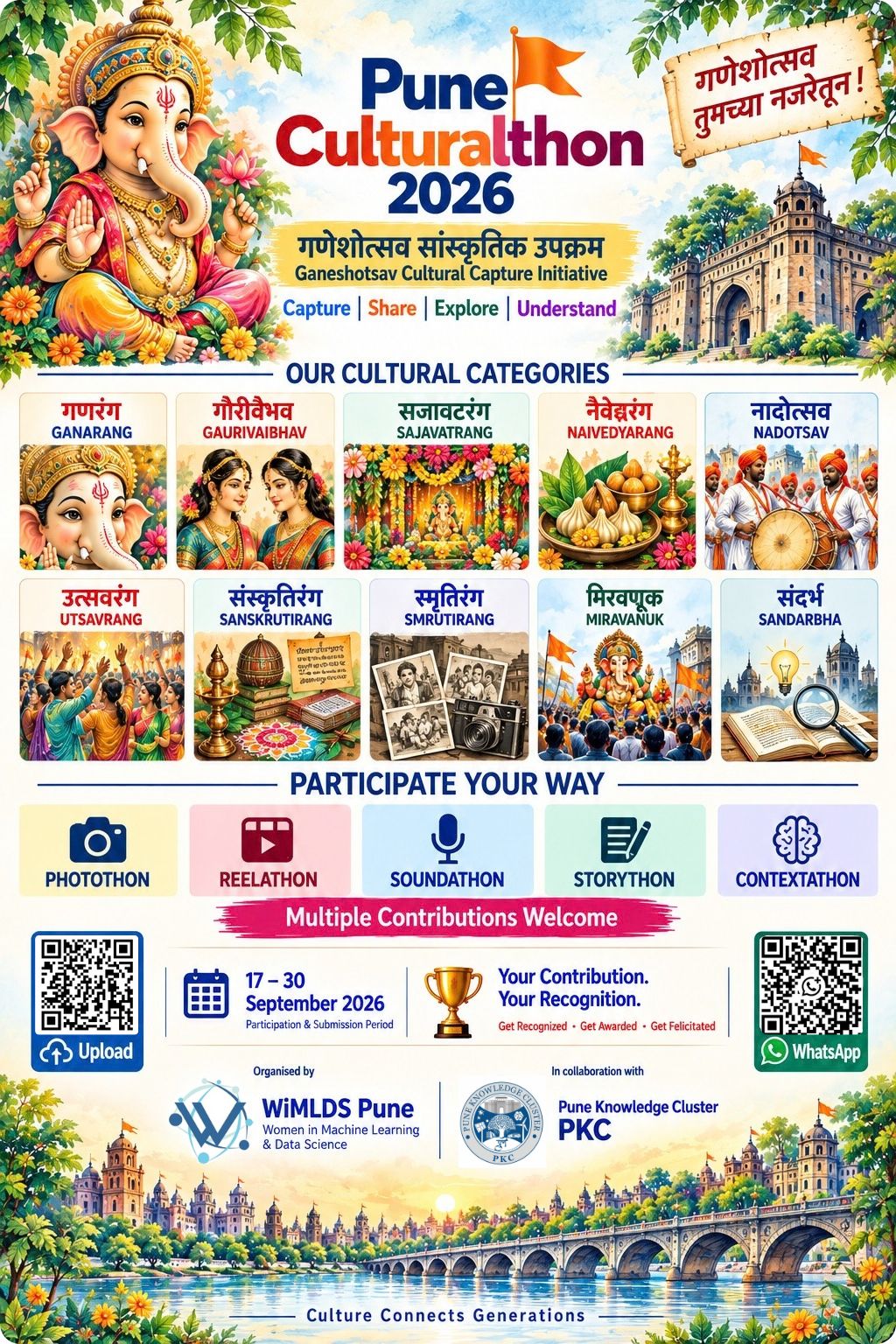
PUNE CULTURALTHON 2026 – GANESHOTSAV CULTURAL CAPTURE CHALLENGE 2026
A First-of-Its-Kind Citizen-Science and Cultural Research Initiative
Organised by WiMLDS Pune in collaboration with Pune Knowledge Cluster (PKC)
17–30 September 2026
ABOUT THE INITIATIVE
The Ganeshotsav Cultural Capture Challenge 2026 invites people around the world to share their knowledge, wisdom, memories, experiences, sounds, stories and cultural practices associated with Ganeshotsav.
The objective is not merely to receive photographs, reels, audios or videos but we want meaningful stories, writeups, articles, opinions, beliefs, change and traditions behind every contect. The initiative seeks to study the cultural context & history or science behind what people see, hear, practise and remember.
Through citizen participation, the research aims to discover, understand and preserve:
- Rare, local and family-specific cultural knowledge
- Knowledge carried through memories and oral traditions
- Regional and community variations in the same practice
- Traditional knowledge held by performers, artisans, priests, mandals, families and communities
- Practices people follow without fully knowing their meaning, history or purpose
- Traditions that have survived, changed or disappeared
- Positive and negative changes in Ganeshotsav over time
- Local names, cultural terms, regional words, dialects, pronunciations and expressions
- Sounds, techniques, rituals and practices that have not been widely studied
- Cultural information that AI may not know, may know only partially or may misunderstand
The initiative encourages people to move:
- From an object to its meaning
- From a photograph to its explanation
- From a sound to its technique and purpose
- From a ritual to its history and significance
- From a memory to an understanding of cultural change
- From a local word to its pronunciation, meaning and usage
- From an AI response to identifying and correcting a cultural knowledge gap
- From celebration to a deeper understanding of culture
AREAS OF CULTURAL RESEARCH AND STUDY
The research may explore:
- Different forms, postures, materials and representations of Ganpati & beyond that
- Different forms, local names and family or regional practices associated with Gauri
- Shankhanad—its forms, techniques, duration, occasions, meanings, traditional beliefs and available scientific knowledge
- Dhol-Tasha taals, compositions, instruments, formations, training methods, pathaks and performance practices
- Taal, Zanj, Lezim, Ghanta, Aartis, Atharvashirsha, mantras, bhajans and other festival sounds
- Individual and mass recitations, pronunciation styles and live chanting compared with recorded playback
- Rituals, symbols, objects, offerings, Mushak and other representations of Ganpati’s Vahan
- Decorations, makhars, themes, dekhavas, live plays and cultural performances
- Modak, Prasad, Naivedya, traditional recipes, preparation techniques and food memories
- Preparation, Aagman, installation, daily rituals, processions, Visarjan and farewell practices
- Family, community, village, mandal and regional traditions
- Traditions retained or adapted outside India
- Environmental practices, idol materials, plastic use, Nirmalya management and changing immersion practices
- Commercialisation, convenience, employment and entrepreneurship, especially for women
- The use of technology, machinery and special effects in celebrations
- Changing participation by young people, women, government bodies, local authorities and political organisations
- Traditions that have survived, changed or disappeared
- Memories and experiences from earlier generations
- Local cultural names, terminology, dialects, pronunciations and expressions
- Cultural knowledge that AI may not fully understand
WHAT KIND OF CONTRIBUTIONS ARE WE LOOKING FOR?
A strong contribution should not simply say:
“Here is our Ganpati.”
It should tell us:
“This is the form of Ganpati installed in our family. It is locally called ______. Our family has followed this practice for ______ generations. It is performed this way because ______. We learned it from ______. It differs from other practices because ______. Earlier, we did ______, but now we do ______. This photograph, audio or video demonstrates ______.”
Photographs, reels, videos, audios, interviews, stories, memories, articles, drawings, sketches and historical material are welcome. Their value increases when they are accompanied by detailed and accurate cultural information.
Every contribution should ideally answer as many of these questions as possible:
- What is it?
- What is its local or traditional name?
- How is the name pronounced?
- Where is it practised or found?
- Who practises, creates or performs it?
- When is it performed?
- How is it performed, practised or created?
- Why is it done this way?
- What does it mean?
- What is its history or origin?
- What is its cultural, religious, social, artistic or scientific significance?
- What makes it different, rare or unique?
- How and from whom was this knowledge learned?
- How old is the tradition or practice?
- Is it specific to a family, village, region, mandal or community?
- Is there a story, belief, emotion or memory connected with it?
- Has it changed over time?
- What has been gained or lost through that change?
- Is it surviving, changing or disappearing?
- Who is the source of the information?
- Is there any supporting audio, video, photograph, written account or historical material?
- Is there something about it that most people—or AI—may not know?
Where possible, participants may also add the date or approximate period, location, GPS information, festival day, name of the person or group involved and relevant tags.
EXAMPLES OF CONTRIBUTIONS WE ENCOURAGE
- Three types of Shankhanad performed in a community and what each one signifies
- A Dhol-Tasha taal known mainly within a particular pathak
- How one family’s form of Gauri differs from those of neighbouring families
- A ritual followed for generations whose original meaning is no longer widely known
- A Ganpati form, cultural name or local word that AI identified incorrectly
- A festival sound, skill or practice that is disappearing
- A tradition remembered by a grandparent but no longer followed by the family
- Changes in the participation of women and young people in a pathak or procession
- How a handmade decoration became a professional product, workshop or annual family activity
- How recorded Aartis, mantras or Atharvashirsha have affected participation, learning and collective experience
- A positive or negative change observed in Ganeshotsav over the years
- A change that led to the loss of a traditional skill or community activity
- A profession, service, enterprise or livelihood that has emerged around Ganeshotsav
- A local word, pronunciation or expression that people outside the region may not understand
- Something common within a family or community that may be unknown elsewhere
- A tradition that has been retained or adapted outside India
SPECIAL PARTICIPATION TRACKS
SMRUTIRANG – SENIOR CITIZEN MEMORYTHON
Senior citizens are specially invited to share their memories, observations, knowledge and experiences through audios, videos, photographs, handwritten accounts, articles or any other convenient medium and in any language.
Old photographs accompanied by dates, locations, memories and stories are especially welcome.
YOUNG CULTURAL EXPLORER
Students and young people may interview grandparents, great-grandparents, parents, neighbours, artisans, performers, priests, mandal members and community elders.
They are encouraged to explore and share the history, beliefs, purpose and cultural meaning behind the traditions in which they participate.
CONTEXTATHON – CHALLENGE AI
Participants may ask AI about a Ganpati or Gauri form, ritual, local word, family custom, sound, instrument, symbol, decoration, procession, Visarjan practice, story or memory.
If the AI response is incorrect, incomplete or misses the cultural context, participants may share:
- The question asked to AI
- The AI response
- What was incorrect, incomplete or missing
- The correct or additional cultural context based on their knowledge or source
- Supporting photographs, audios, videos, stories or references, wherever available
AI may know the object. You may know the context.
To summarize,
Do not just show us your Ganeshotsav. Tell us what is unique about it, what it means, how it is practised, how it has changed and what you know that may not have been widely studied—or may not even be known to AI.
The real objective is to bring citizens’ knowledge, wisdom, memories, sounds, visuals and experiences into meaningful cultural research that supports preservation and a deeper understanding of India’s cultural context.
TERMS AND CONDITIONS FOR PARTICIPATION
WHO CAN PARTICIPATE?
The challenge is open to anyone & everyone around the world, including:
Individuals, families, children, students, senior citizens, housing societies, Ganesh mandals, public pandals, cultural groups, pathaks, performers, photographers, schools, colleges, researchers, institutions and communities.
Participants may enter individually or as a family, group, society, mandal, community or institution.
They may participate in one, several or all categories and may submit multiple contributions.
There is no restriction on the number of contributions.
LANGUAGE
Contributions may be submitted in Marathi, Hindi, English, any Indian or international language, regional language or local dialect.
Translation into English is not required.
Local words, traditional terminology, regional names, dialects, pronunciations and expressions are especially welcome!
CONTENT FORMATS
Participants may submit:
Photographs • Images • Drawings • Sketches • Reels • Videos • Audios • Voice Messages • Interviews • Stories • Memories • Oral Histories • Articles • Recipes • Written or Handwritten Accounts • Historical Material • Cultural Information
Current as well as older material may be submitted.
Old photographs, audios, videos and written material should preferably be accompanied by an approximate date, location and related story or explanation.
CONTENT QUALITY AND FILE SIZE
- Maximum file size: 1 GB per file
- Reels should preferably be limited to 30 seconds
- Please upload the original, clear and high-quality file wherever possible
- Photographs should preferably be uploaded in their original resolution
- Videos should preferably be clear and stable, with understandable sound
- Audios should be recorded in a reasonably quiet environment so that speech, music or performance can be heard clearly
- Drawings, sketches and handwritten accounts may be scanned or photographed clearly
- Files should not be unnecessarily compressed if this affects their quality
- Participants may add the location, GPS information, date, timeline and relevant tags wherever available to add value and more information to the study
RIGHT TO SHARE
Participants must have the necessary permission or right to share the submitted content.
If another person is clearly visible, interviewed or recorded, participants should obtain that person’s permission before submitting the content.
Children’s contributions should be submitted with the knowledge and permission of a parent, guardian, school or responsible adult, as applicable.
Please avoid sharing private, confidential, offensive, misleading or unlawfully obtained content.
Participants may use AI tools to organise, translate, refine or present their contributions. However, the knowledge, experiences, views, opinions, stories and cultural information shared must be original and authentic. Contributions consisting entirely of AI-generated content will not be considered.
ACCURACY AND SOURCES
Participants should share information honestly and as accurately as possible.
Where the contribution is based on a family memory, oral tradition, elder, performer, priest, artisan, book or another reference, participants are encouraged to mention the source.
Traditional beliefs, personal experiences and scientific information should be identified appropriately rather than presented as the same type of evidence.
SUBMISSION GUIDELINES
SEND OR UPLOAD
Share a photograph, image, drawing, sketch, reel, video, audio, interview, story, memory, article or other relevant material.
TAG
Add relevant tags or descriptive words in any language or dialect. Please use the actual local or traditional word wherever possible.
TELL
Explain in as much detail as possible:
- What the content shows or records
- Its local or traditional name
- Where and by whom it is practised
- Its meaning and cultural context
- What makes it special or unique
- Its history, source, story or associated memory
- How it has changed over time
HOW TO SUBMIT
GOOGLE FORM
Submit through the Google Form:
https://bit.ly/puneganeshotsav2026
Submit through WhatsApp:
Note: The WhatsApp number for submitting contributions is different from the contact number provided below for queries.
AWARDS, RECOGNITION AND RESEARCH OUTCOME
Contributions will be recognised for cultural richness, uniqueness, wisdom, knowledge, accuracy, completeness, stories and memories, as well as visual and technical quality.
Recognition may include photographs, reels, cultural stories, senior citizens’ memories, student discoveries, Ganpati and Gauri forms, decorations, food stories, festival sounds, Shankhanad, sustainable practices, unique traditions, cultural collections and the “AI May Not Know This” Award.
Student Participants will receive participation certificates & internship and job opportunities.
Selected contributors and winners will be credited by name, subject to their consent in our research report, and felicitated at programmes.
Winners may receive awards, goodies, gift hampers, vouchers or special opportunities.
The knowledge and insights shared through the initiative will contribute to cultural research and thematic studies. The findings will be consolidated into a research paper or final research report and published on various platforms.
CONTACT FOR QUERIES
Contact Person:
Ms Sucheta G. Dhere, Founder, WiMLDS Pune
Email: [email protected]
Mobile/WhatsApp: 8446432338
About the Organizers
WiMLDS and PKC are not-for-profit organisations committed to creating learning and research opportunities for students, researchers and communities, while enabling citizens to benefit from culturally rich research.
Pune Knowledge Cluster was established by the Office of the Principal Scientific Adviser to the Government of India. The Office of the PSA provides pragmatic and objective advice to the Prime Minister and the Cabinet on matters related to science, technology and innovation, with a focus on applying science and technology across critical infrastructure and economic and social sectors in partnership with government departments, institutions and industry.
WiMLDS is a Global not-for-profit community that supports learning in advanced technologies, encourages women leaders and role models, helps women return to work, and provides community members with hands-on experience through real-world projects and problems.